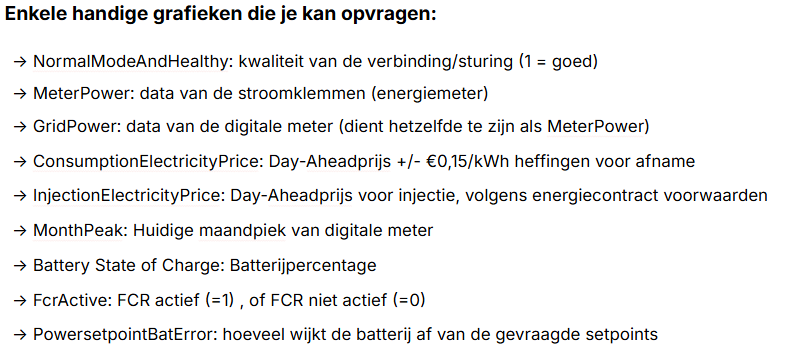
Purpose: quick reference of time-series graphs available in the Partner Portal
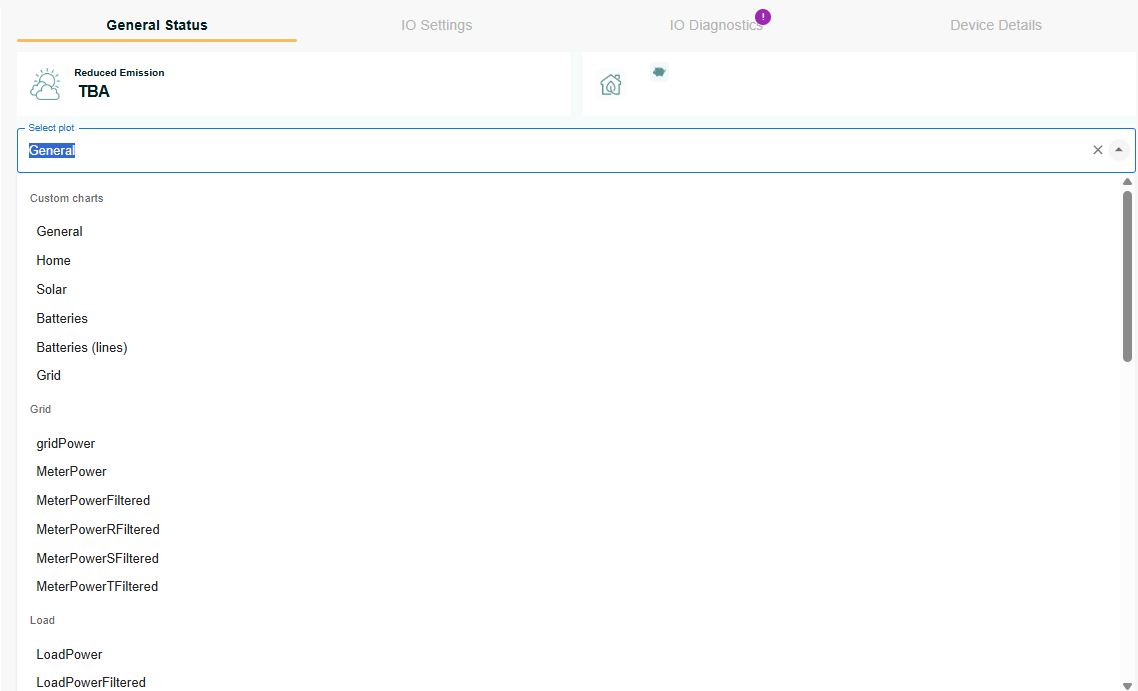
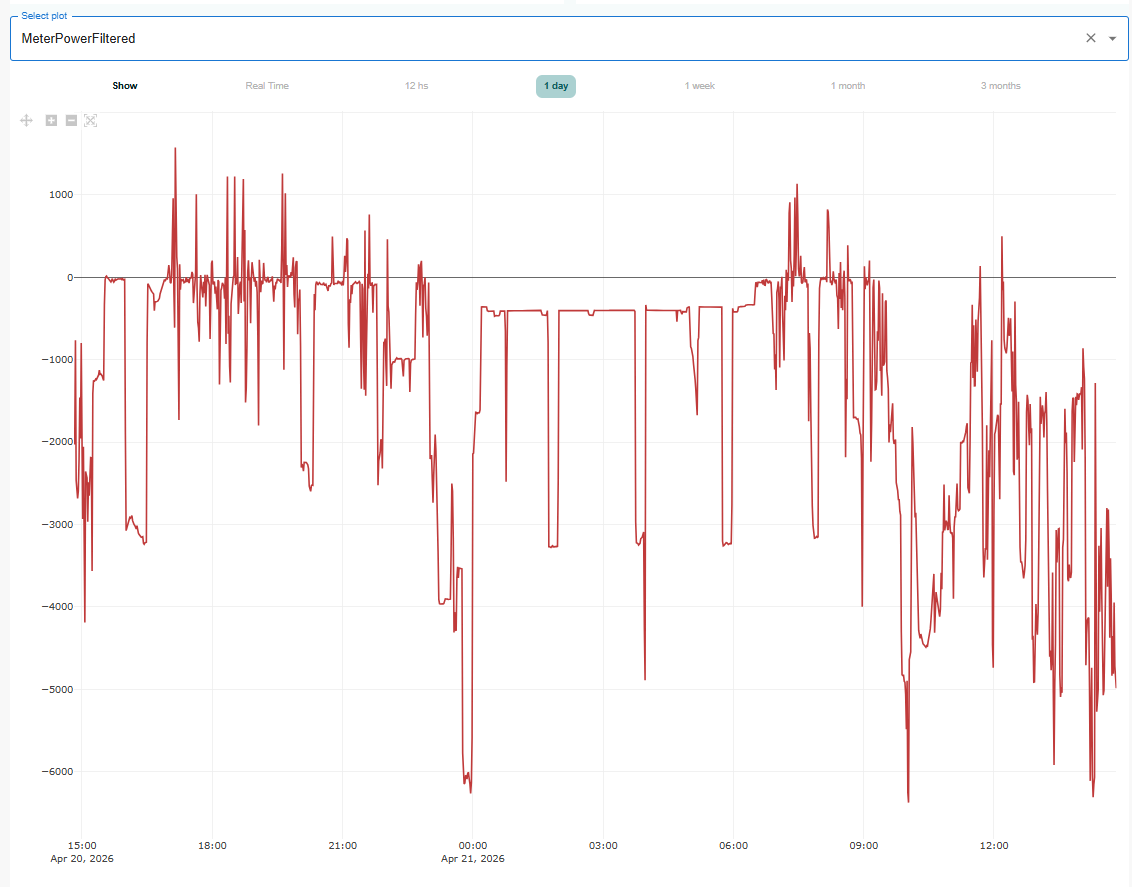
Graph overview
|
Group |
Graph |
Info |
|---|---|---|
|
Custom charts |
General |
Default “General status” time‑series view. Shows a high‑level selection of key signals (varies by configuration) to quickly spot anomalies and trends. |
|
Extra configuration: |
General |
Toggle Solar, Battery, Grid, Home & EV |
|
Custom charts |
Home |
Household overview chart (typically includes consumption + production + battery and related signals) to understand the energy balance at a glance. |
|
Custom charts |
Solar |
Solar/PV production focused chart (PV power time‑series) to understand generation patterns and drops/spikes. |
|
Custom charts |
Batteries |
Battery focused chart (SoC, battery power, setpoints, and related health/error signals depending on config). |
|
Custom charts |
Batteries (lines) |
Same battery domain as above, but rendered as line series to compare multiple battery signals over time more clearly. |
|
Custom charts |
Grid |
Grid/meter focused chart (import vs export and meter/grid power signals) to understand interaction with the grid. |
|
Grid |
gridPower |
Instantaneous power at the grid connection point. Sign convention depends on implementation, but typically positive = import (consumption from grid) and negative = export (injection to grid). |
|
Grid |
MeterPower |
Total power measured by the meter (raw). Used as the basis for grid import/export calculations. |
|
Grid |
MeterPowerFiltered |
Filtered/smoothed meter power. Used for UI graphs and calculations that should be less sensitive to spikes/noise. |
|
Grid |
MeterPowerRFiltered |
Filtered meter power for phase R (L1). Useful for diagnosing phase imbalance or phase-specific issues. |
|
Grid |
MeterPowerSFiltered |
Filtered meter power for phase S (L2). Useful for diagnosing phase imbalance or phase-specific issues. |
|
Grid |
MeterPowerTFiltered |
Filtered meter power for phase T (L3). Useful for diagnosing phase imbalance or phase-specific issues. |
|
Grid |
powerSetpointMeter |
Target (setpoint) for meter/grid power used by EMS control (what the system is trying to achieve at the grid connection point). |
|
Grid |
powerSetpointMeterError |
Difference between actual meter power and the meter setpoint. Indicates tracking quality / control error (0 = perfect tracking). |
|
Load |
LoadPower |
Instantaneous household load/consumption power (raw). |
|
Load |
LoadPowerFiltered |
Filtered/smoothed household load power, used for UI graphs and more stable calculations. |
|
Load |
totalEVPower |
EV charging power (total). Shows how much power is currently going to EV charging. |
|
Solar |
totalPVHybridPowerFiltered |
Filtered PV power from hybrid inverter setups (when applicable). Represents solar generation measured/derived via hybrid inverter telemetry. |
|
Solar |
totalPVPower |
Total PV production power (raw). |
|
Solar |
totalPVPowerFiltered |
Filtered/smoothed total PV production power. |
|
Solar |
totalPVRetrofitPowerFiltered |
Filtered PV production from retrofit measurement paths (when applicable). Used when PV is measured via retrofit clamps/meters rather than inverter-native telemetry. |
|
Battery |
Battery State of Charge |
Battery state of charge (SoC) over time, usually as a % of usable capacity. |
|
Battery |
BatteryVoltageInv |
Battery/inverter DC voltage (raw). Useful for diagnostics and validating battery/inverter behavior. |
|
Battery |
batteryVoltageInvFiltered |
Filtered/smoothed battery/inverter DC voltage. |
|
Battery |
powerSetpointBatError |
Battery power tracking error: difference between battery power setpoint and actual battery power. |
|
Battery |
stateOfChargeFiltered |
Filtered SoC time‑series (smoothed), useful to avoid jitter in visualizations. |
|
Battery |
stateOfHealth |
Battery state of health (SoH): an indicator of battery degradation / remaining usable capacity vs nominal. |
|
Battery |
stateOfHealthFiltered |
Filtered/smoothed SoH. |
|
Peaks |
monthPeak |
Monthly peak power metric used for capacity tariff / peak tracking (highest measured peak in the month, depending on definition). |
|
Market |
capacityTariffPrice |
Capacity tariff price component over time (used in cost/savings calculations and reporting). |
|
Market |
consumptionElectricityPrice |
Electricity consumption price (what it costs to consume/import energy) over time. |
|
Market |
consumptionReferenceElectricityPrice |
Reference/baseline consumption price used for comparisons (e.g., to compute savings vs a reference tariff). |
|
Market |
injectionElectricityPrice |
Electricity injection price (what you get paid for exporting/injecting energy) over time. |
|
Market |
injectionReferenceElectricityPrice |
Reference/baseline injection price used for comparisons. |
|
EMS |
emsComputationTime |
EMS computation/execution time. Useful for spotting performance regressions or abnormal compute duration. |
|
EMS |
intent |
EMS intent/state label describing what the EMS is trying to do (control mode / decision outcome) at a given time. |
|
EMS |
normalModeAndHealthy |
Health/mode flag indicating whether the system is in normal mode and healthy (often used as a quick quality/availability indicator). |
|
Power Quality |
ACFrequency |
Grid AC frequency (Hz) measured at the site/inverter. Used for power quality and FCR-related analysis. |
|
Power Quality |
voltageL1 |
AC voltage on phase L1. |
|
Power Quality |
voltageL2 |
AC voltage on phase L2. |
|
Power Quality |
voltageL3 |
AC voltage on phase L3. |
|
Delivery |
dayAheadPosition |
Day-ahead nominated/expected position (energy schedule) over time; used for market/balancing context. |
|
Delivery |
imbalancePositionAgainstDAT10H |
Imbalance position vs a day-ahead reference (T+10h), used to analyze deviations and potential imbalance costs. |
|
Delivery |
fcrActive |
FCR activity status/metric indicating whether the system is actively delivering FCR at that moment (activation present / control engaged). |
|
Delivery |
frequencyResponseCapable |
https://docs.lifepowr.io/installer/v1/troubleshooting-frequencyresponcecapable |
|
Delivery |
frequencyResponseAllocation |
The volume of converter power (in kW) allocated to FCR (Frequency Containment Reserve) for each 4-hour block of the day. The EMS determines this by weighing potential FCR income against the opportunity cost of reducing available battery/converter capacity for self-consumption, peak shaving, and dynamic tariff optimization. Typical pattern: less allocation during the day, more at night. |
|
Delivery |
frequencyResponseActivation |
The actual FCR power being delivered in real time, proportional to how much the grid frequency deviates from 50 Hz. When frequency drops, the system injects power; when it rises, it absorbs power. |
|
Delivery |
imbalanceActive |
A flag computed by the EMS indicating whether the site is actively participating in the Imbalance market at a given moment. When set, charging when the grid has a surplus, discharging when there is a shortage. |
|
Delivery |
imbalancePower |
The instantaneous power (W) attributed to imbalance market activity. Shows the power the site is delivering or absorbing as part of its imbalance market participation — the portion of battery charge/discharge directed by imbalance market signals rather than local optimization. |
|
Grid |
eastronGridPower |
Grid power as measured by a HomeWizard Eastron sub-meter installed at the grid connection point. Used on sites where a dedicated Eastron kWh-meter provides a reliable current stream to FlexiO for steering and monitoring, as an alternative or supplement to the P1 measurement. |
|
Solar |
inverterPVRetro |
Gathers information about the extra clamp to read measurements for inverters like GoodWe, Solis. |
|
Solar |
EastronPVRetro |
PV retrofit production measured by a HomeWizard Eastron sub-meter installed on the AC output of a retrofit (non-hybrid) solar inverter. Used when a separate Eastron meter accurately measures the production of a retrofit inverter that FlexiO monitors but cannot actively control. |
|
Solar |
PV1Power |
Instantaneous power (W) from the first PV string or MPPT input on the inverter. Corresponds to the first solar panel group connected to the hybrid inverter. Useful for comparing output across PV string configurations or diagnosing string-level issues. |
|
Solar |
PV2Power |
Instantaneous power (W) from the second PV string or MPPT input on the inverter. Corresponds to the second solar panel group on the hybrid inverter. Used alongside PV1Power to monitor multi-string setups and identify asymmetry or faults between strings. |
|
Battery |
EnergyLossFiltered |
Filtered/smoothed estimate of energy losses in the battery/inverter system (W). Captures conversion and efficiency losses during charge and discharge cycles. Useful for monitoring system health, identifying degradation, and verifying that losses remain within expected bounds. |
|
Peaks |
monthPeakPVOnly |
The highest 15-minute average grid import peak of the month, measured during periods where only PV production (without battery discharge) influences net import. Used to analyze the contribution of solar generation to peak reduction, independently of battery behavior. |
|
Peaks |
monthPeakLoadOnly |
The highest 15-minute average grid import peak of the month, attributed to household load only (excluding PV and battery contributions). Isolates raw consumption demand and shows the underlying load peak before any FlexiO optimization is applied. |
|
Power Quality |
TotalInvPower |
Total instantaneous AC power output (W) of all inverters at the site combined. Provides a consolidated view of total inverter capacity utilization; useful for diagnosing inverter output and cross-checking against other power signals. |
|
Power Setpoints |
powerSetpointBat |
The EMS-computed power setpoint (W) sent to the battery/inverter for charging or discharging. This is the target battery power the EMS is commanding the system to achieve. Sign convention: negative = consumption (charging). Useful for diagnosing whether the EMS is issuing correct commands and whether the battery is following them. |
|
Power Setpoints |
powerSetpointACDCError |
AC/DC conversion setpoint error (inverter control tracking). Used for deeper diagnostics of inverter/battery control loops. |
|
Power Setpoints |
powerSetpointGeneric |
A generic EMS power setpoint (W) for controllable loads or devices that do not fall under the specific battery, meter, or AC/DC categories. Can be used to control third-party devices (e.g. Shelly switches) integrated into the FlexiO ecosystem based on EMS optimization decisions. |
|
Power Setpoints |
powerSetpointMeter |
The EMS-computed target power (W) for the grid connection point (meter). This is what the EMS is trying to achieve at the grid — e.g. zero export, a fixed import level, or a peak-shaving threshold. Combined with actual meter power, allows checking how well the system is tracking its grid target. |
|
Power Setpoints |
powerSetpointACDC |
The EMS-computed power setpoint (W) for the AC/DC conversion stage of the inverter. Used for inverter types where AC-side and DC-side (battery) setpoints are controlled separately. Relevant for diagnosing the inverter's AC/DC conversion control loop behavior. |
|
Power Setpoints |
totalEVPowerSetpoint |
The total EV charging power setpoint (W) computed by the EMS across all EV chargers at the site. This is the target power sent to the EV charging infrastructure, based on available solar, battery state, grid limits, and peak-shaving objectives. |
Tips